
Substack accelerates in Europe: global scale, local execution
More than $90 million in annual revenue for European creators and nearly 30,000 publishers outside the U.S. confirm Substack’s real takeoff across the continent

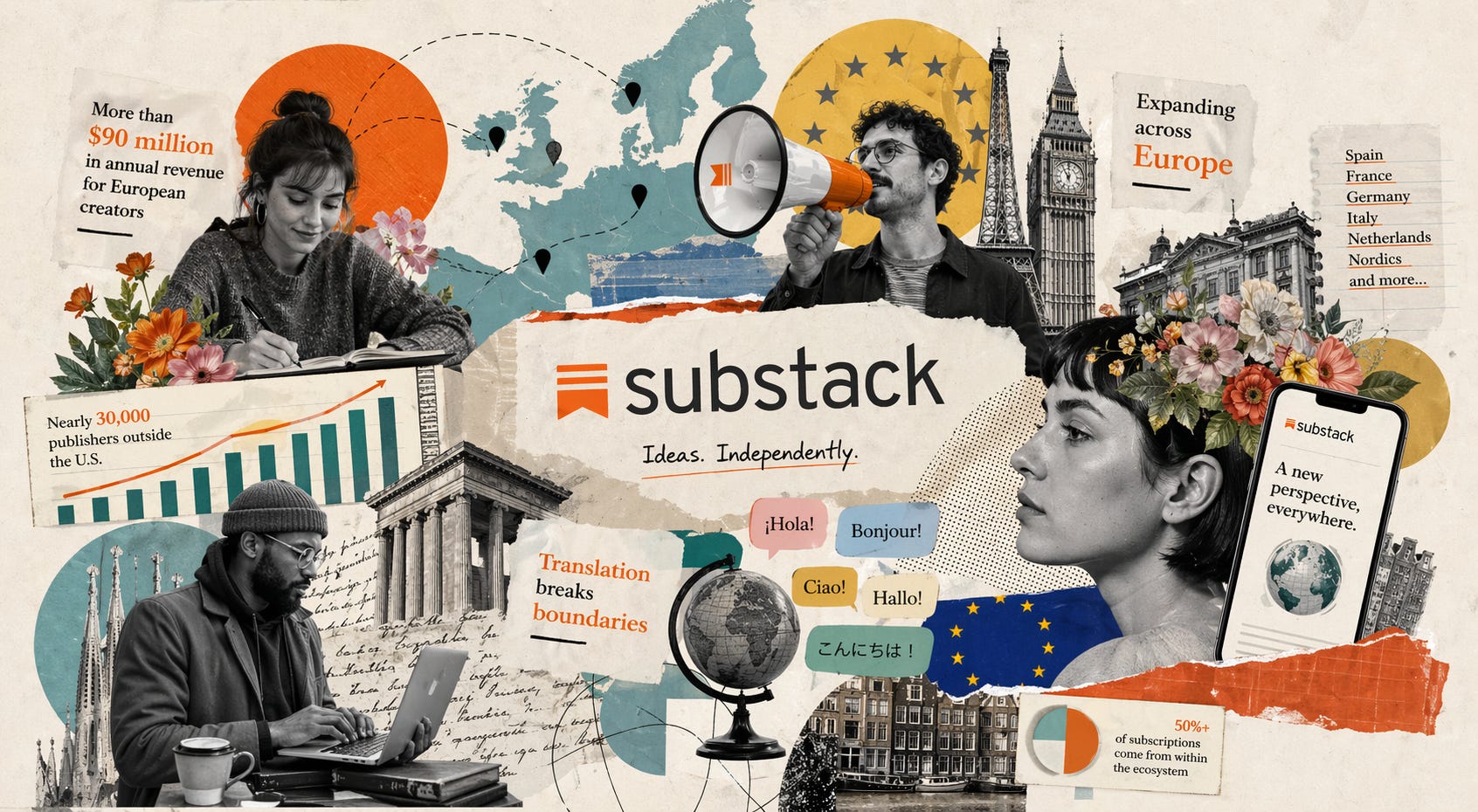
Substack has crossed a threshold: over $90 million annually generated by European creators and nearly 30,000 publishers outside the U.S. earning money. Expansion is no longer exploratory; it’s structural. And it rests on two clear vectors: product (translation, payments, network effects) and local deployment (teams, partnerships).
“Spain isn’t starting from scratch: there’s a real base and demand”
This is where Marcos García @Substack, Head of Partnerships in Spain, grounds the strategy operationally. His diagnosis is precise: tens of thousands of publications and more than 150,000 paid subscriptions, growing almost entirely organically. He’s not talking about market education, but about accelerating what already works.
His objective is tactical: helping journalists, creators, and media organizations understand “what is truly possible to build” on Substack. In practice: moving from presence to business.

From reach to ownership: the key shift
García identifies the core bottleneck: many creators have built audiences on external platforms but haven’t taken the step toward owning that relationship or monetizing it directly. His thesis is clear: that step is not optional—it’s the strategic decision for the long term. In a context of algorithmic dependency and declining ad revenue, Substack positions itself as a direct alternative: control over subscriber data, recurring revenue, and less intermediation.
“More than 50% of subscriptions come from within the ecosystem”
Here lies one of García’s most distinctive arguments: the internal network effect. More than half of subscriptions don’t depend on external traffic but are generated within Substack itself. This shifts the traditional growth logic: it’s not just about acquisition, but about activating an internal market predisposed to pay. For creators and media companies, this is a distribution layer that’s hard to replicate independently.
Automatic translation turns Substack into a global market by default
The push into translation is not just another feature—it is arguably Substack’s most consequential strategic move in its international expansion. By enabling Notes to be translated from English into 15 languages and into English from more than 100 languages—and soon extending this to posts—the platform removes one of the internet’s last major structural barriers: language as a limit to scale. This fundamentally reshapes the potential market for any creator: a newsletter written in Spanish no longer competes only within Spain or Latin America, but enters a global circulation of ideas where a reader in Tokyo, Istanbul, or Amsterdam can discover it frictionlessly. This is not just expanded distribution; it’s a shift in the logic of discovery. Substack evolves from a network segmented by language into an interconnected ecosystem where value is defined by the strength of the voice, not its original language. From a business standpoint, it multiplies each creator’s addressable market without requiring a change in language or editorial strategy; from a cultural standpoint, it operationalizes the internet’s foundational promise—the global exchange of ideas. And in the European context, shaped by linguistic fragmentation, this technological layer is not an add-on: it is the condition that makes true scalability possible.
Europe: global scale, local execution
The pattern is clear: Substack combines global infrastructure (product, network, translation) with local activation (teams, partnerships, community). Spain is one of the first markets where this model is being deployed with dedicated leadership.
The bottom line, in García’s terms: the market already exists, demand is real, and the window is open. The question is no longer whether Substack will work in Europe, but who will move fastest to turn that opportunity into a sustainable business.
As highlighted by We Are Digital Diplomacy, Substack builds its international footprint with local editorial hires. Also, between 2021 and 2024, Substack started to hire local staffers in Europe and elsewhere:
Farrah Storr in the UK — now head of international
Andreas Laux in Germany (since 2023)
Marissa Cox in France (since February 2024)
Ruth Devine in Australia (March 2024 - October 2024)
Just in the past few months, Substack hired:
Chiara Santoro in Italy
Marcos García @Substack in Spain (Interview)
Renée Kaplan in France
Margot James in the Netherlands
Annabelle Russell for Australia and New Zealand
Mark Swierszcz in Canada

